

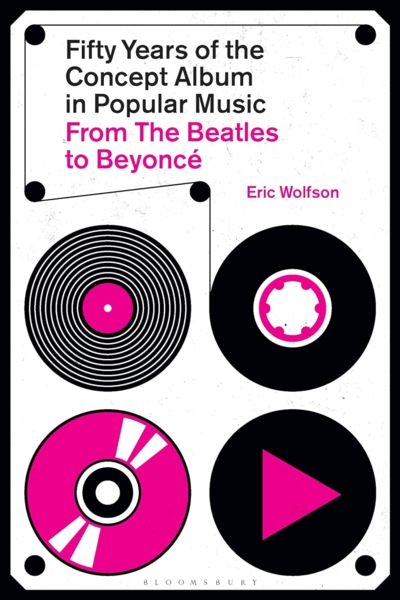
From the book Fifty Years of the Concept Album in Popular Music: From The Beatles to Beyoncé
In 1970, the Beatles' breakup shook the rock world to its core. More than any other group, the Beatles united rock and roll, creating a community that ushered the genre from a teenage music to an adult one. Now the community had no center. Increasingly, artists turned away from rock's greater community to look inward at themselves instead of outwards for inspiration. One of the earliest and most extreme examples of this was newly ex-Beatle John Lennon's first post-Beatles solo album, John Lennon/Plastic Ono Band, from late 1970. The album found him reeling from his recent scream therapy, and writing songs to, for, and about himself. The finale, "God," was a Cartesian exercise into what constitutes reality, in which he famously sings that he doesn't believe in Beatles - only in himself (and wife Yoko Ono). "The dream is over," he concludes, surveying the 1960s landscape that cast a shadow over the new decade. When pop/folksinger Joni Mitchell released the similarly introspective album Blue in 1971, some saw a connection, even though Mitchell was subdued and melancholy where Lennon was raw and unflinching. "In four albums, Joni Mitchell has gone from sparkling newcomer to larger-than-life superstar in the fast-moving whirl of pop music," Al Rudis wrote in his review of Blue for The Cincinnati Enquirer. "Thus, like John Lennon, she can now lay her soul bare and expect us to be interested."1
Lennon's main contribution to the singer-songwriter era was one of substance, not sound. Most classic singer-songwriter music was quiet with subtle, introspective lyrics set to pleasant, folk-derived melodies. James Taylor led the way in early 1970 with Sweet Baby James. A year later, Carole King released Tapestry, the best-selling album of the singer-songwriter era, but the era's finest album was Mitchell's Blue. It's telling that these latter two landmark albums were made by solo female performers. For a rare time in rock and roll, here was a style that audiences were prepared to give just as much (if not more) credibility to female performers as male ones. But where some heard gender, Mitchell heard only humanity. "Blue is just human," she once reflected. "Everybody, if they've got a soul, is going to go through those changes, and yet in the spotlight, nobody had ever written them in song ..." As a master of songs about journeying both internal and 2 external, Joni Mitchell was a true pioneer.
Blue evokes a sense of contemplative introspection that is unmatched in rock and roll. Her songs tempt us to read into them like pages in a diary, as though we are using her public act of releasing Blue as a way to connect to her very private expression; indeed, Mitchell once commented about her intimate songwriting style, "The songs have simply been private letters that were published."3 Making the album was a private affair. When asked about the sessions for Blue, she said they were the only sessions "where we locked the door." "Was it a nervous breakdown?" she posited about 4 the sessions in a much later interview. "People became transparent to me. People thought I had the evil eye. That's why we locked off the Blue sessions. Nobody could come in. If anybody came in, I'd burst into tears." But Mitchell's pain proved fertile soil for her art. All of her journeys - physical and otherwise - added up into something beautiful and remarkable. Indicative of the restraint that characterized the album, she included an austere image of her face on the cover, printed in blue.
A dulcimer lays out a punchy rhythm, soon met by the thick chords of an acoustic guitar. The two instruments blend together as the singer begins "on a lonely road" and "traveling, traveling, traveling, traveling," as she looks "for something, what can it be?" Much of the opening "All I Really Want" plays like a stream-of-conscious response to this question, landing on one answer - a love that will "bring out the best in me and you" - before the melody grows somber and she broods deeper, charting a new path of thought. " 'Blue' is less a collection of songs than a piece of music divided into sections," Ellen Willis wrote in The New Yorker in 1973. "Its central theme was travel, literal and spiritual - a familiar folk metaphor, except that instead of a man on the road the traveler was a woman pursuing her female identity through the byways of the pop world." And by the end 6 of "All I Really Want," the singer reveals her goal: "I want to make you feel free."
But if freedom is a major inspiration for and subject of Blue, what did the term mean to Joni Mitchell? In 1972, an interviewer noted how there can be a kind of deception in freedom. "Freedom is deceptive, though," Mitchell agreed. "It's like that line of Kristofferson's 'Freedom's just another way of nothing left to lose.' Freedom implies a lot of loneliness you know, a lot of unfulfillment. It implies always the search for fulfillment, which sometimes is more exciting than the fulfillment itself." Two years later, Mitchell was asked to define freedom. She responded, "Freedom to me is 7 the luxury of being able to follow the path of the heart." puts both of these definitions of 8 Blue freedom into practice. On one hand, the album explores the duality of freedom, especially how loneliness can be the flipside of freedom. Meanwhile, the entire project was a document of an artist following the path of their own heart. And as a travelogue, Blue chases an elusive freedom that focuses on the thrill of the search over the empty promise of a destination.
The following "My Old Man" picks up on the romance of the first song, focusing in on the male recipient of the singer's love. Most of the song is descriptive, filling out the song's subject with the elegant piano and melody. Songs like "My Old Man" seem to invite, if not demand, the listener to try and decode the specifics that inspired it. In this case, the song is generally associated with singer-songwriter Graham Nash, Mitchell's lover who she broke up with just before she began Blue. Mitchell needed to break free from their domesticity and go into the world for an adventure. But first, she reflects upon one of the most significant events in her own life. "Little Green" tells of a baby put up for adoption. The song is likely the oldest one on Blue. Mitchell wrote it in 1967, not long after she gave her own infant child up for adoption, rather than raise it alone and penniless. This private event wasn't made public until three decades later when the two were reunited through internet posts. Mitchell has said that the emptiness left by her daughter led her to write songs in the first place, and indeed, she's only released a fraction of new songs compared to her output before reuniting with her daughter. "Little Green," She sings towards the end of the song, "Have a happy ending."
Cashing in on her claim on traveling in "All I Want to Do," while processing the breakup of "My Old Man" and the lingering pain of "Little Green," the singer flees California and heads to a cave dwelling hippie commune in Matala, Crete, as Mitchell herself did before recording Blue. While there, Mitchell met Cary Raditz, a tough and rootless rambler. They became acquainted and she moved into his cave, beginning a relationship that lasted about two months. She wrote a song about him that she misspelled as "Carey," and included it on Blue. It is the album's closest thing to a pop- 9 rock song, as the rhythm section grounds the soaring melody and sing-along refrain. But the relationship was short-lived. Mitchell originally went to Matala to be anonymous, but Cary noticed a change when she was approached by reporters and invited them to join her and Cary. In hindsight, Cary saw this as "when she really changed her whole life, from being somewhat at the effect of other people, to becoming the cause itself." Raditz's observations provide an interesting context for 10 Blue . The idea that Mitchell had gone from an "effect" to a "cause" shows a woman taking her own initiative, and framing the world on her own terms. As an emotional document, this is what Blue is all about.
Closing out the album's first side is its title track, a song as guarded and stark as "Carey" was opening and inviting. "Blue" is one of the most uncompromised songs on the album, with lines that grow and shrink over a melody that rises and falls depending on the feeling of the lyric. After its killer opening line - "Songs are like tattoos" - it keeps hanging up words like clothes on a clothesline, until it cascades with a decade's worth of angst in a few choice lines: "Acid, booze, and ass," followed by "Needles, guns, and grass." But if the lyrics looked backward, the music looked ahead, creating a blueprint for countless female singer-songwriters in the 1990s. Still, as the singer puts it, "Blue" is just "a foggy lullaby," a eulogy for a recent era that already felt like a thousand years ago.
The second side of Blue opens with the singer sitting in a park in Paris, France. In the second verse, she is in the Grecian Isles; by the third, she is on a plane to Spain. In each place, her heart longs for her home that comprises the song's title, "California." Like so many things on the album, the singer takes an idea and personifies it, singing to the state as though it were a lost lover. She even flashes back again to Cary/"Carey," now describing him as a goat-dancing rogue who stole her camera to sell. (The real-life Raditz maintains that Mitchell gave him the camera as a gift and when he warned her that he would probably sell it, she said to go ahead.) The question she asks of California - "Will you take me as I am?" - hangs over the album, summing up the entire singer-songwriter movement in seven simple words. Her question marks a turning point, a conscious shedding of the carnival masks and psychedelic costumes in favor for something far more revealing. "That's how I felt," she later explained. "Like my guts were on the outside. I wrote Blue in that condition."11
In true narrative style, the album's following song, "This Flight Tonight," answers the homesick longing of "California" by placing the singer on an airplane descending over the sands of Las Vegas. The song works as a snapshot of a mind in several places at once - on one level describing the literal events of the flight, on another level thinking about her love she's flying home to see, and on yet another level, deeper questions of a higher order. But there is a sense of hesitation in "This Flight Tonight," a pang of regret to which the singer keeps on returning: "Turn this crazy bird around," she sings. The singer finds herself trapped in a paradox - returning home makes her want to take flight once again. It is this insatiable feeling of restlessness disguised as freedom that gives Blue much of its power, and the energy to keep moving forward in a crooked line.
Mitchell begins the following "River" with a sound that comes from another universe: choppy piano notes playing the refrain of "Jingle Bells." The familiarity of the melody takes you away to a distant, nostalgic place that sneaks up on you no matter how many times you've heard "River." But then Mitchell weaves it into a song of her own. She sings in glimpses, watching people go about their holiday chores before unleashing a soaring refrain where she wishes for a river to skate away on. Now that it's a modern holiday standard, Mitchell gets frustrated by those who deny it's a Christmas song. "It's absolutely a Christmas song," she told The Los Angeles Times as Blue reached its fifty-year mark. "It's a Christmas song for people who are lonely at Christmas! We need a song like that." Mitchell knew a thing or two about being lonely at Christmas. At the age of ten, she was 12 diagnosed with polio and shipped off to live in a children's polio colony. Though she wanted to go home for Christmas, she ended up spending it alone in the colony, where the wheezing sounds of the iron lungs could be heard through the night. Songs like "River" - with the way Mitchell spaces out her words, the placement of chord changes, and the song's existential loneliness - speak to the secret musical source of Blue, a source so subtle it hides in plain sight: the blues. While Blue is not a blues album per se, it uses a stripped-down sincerity that accompanies the confessional element of the music that echoes the blues. As her title implies, her blues are not the blues, but rather they are Blue, something so personal that it must be capitalized and kept in the singular.
In the next song on Blue, "A Case of You," Joni Mitchell proves herself as the greatest writer of dialogue in rock music. In the song, the singer recalls how a former lover called her as constant as a northern star. She flips this on its head and interprets it to mean she's constantly in the darkness. She then turns away from her companion and tells them that if they need her, she'll be in the bar - and presumably, in the darkness. All of this is conveyed in an economy of words that she's even able to make rhyme. "A Case of You" grows from this intimate dialogue of secular love into a song about the intimacies of faith. "You're in my blood like holy wine," she sings in the refrain. Her song transcends from a confession into a holy rite, yet one that is made entirely unto itself; there's no priest to administer the sacraments, only the singer and whatever form of God she may believe in. And yet, by placing this on an album, she is confessing to everyone. Therein lies the paradox of the singer-songwriter movement: It is a style marked by the singer's private thoughts and introspection, but simultaneously had to reach a wide audience to be successful. If there is anyone in the equation who serves as the role of the priest hearing the confessions, it's us, the audience.
Blue concludes with the haunting "The Last Time I Saw Richard." The singer begins by bluntly putting the title question to rest: the last time she saw Richard was in Detroit in 1968. Richard tells her that all romantics are doomed to be "Cynical and drunk and boring." When the singer laughs at him, Richard chides her for liking flowers and pretty men. He then puts some songs on the jukebox, leading the singer to point out that, despite his cynicism, he selected sweet love songs. In the final verse, the singer descries how Richard married a figure skater, got the status symbols of suburban life, and drinks at home in front of the television with all the houselights on. That's where the singer draws the line. "I'm gonna blow this damn candle out," she sings. The difference between Richard and the singer is that where Richard sees a dead end, the singer sees a new beginning. For her, the bar is merely "a dark cocoon" where she can "get my gorgeous wings and fly." With the determined hope of "The Last Time I Saw Richard" at the end, Blue is an extended meditation of loneliness and love, and the dark places they can lead. And the singer uses the same little-girl imagery that Richard mocks her for and welds it to her song to break free like a butterfly.
Taken all together, Joni Mitchell's Blue more than lives up to its name. As one listens (and relistens) to the album, the color blue springs up everywhere, almost always in a different form: An emotion ("we both get so blue" in "All I Want"), a genre ("keeping away my blues" in "My Old Man"), a color ("her eyes are blue" in "Little Green"), a muse ("Blue, there is a song for you" in "Blue"), an expression (reading the news "gives you the blues" in "California"), even the glow of a television ("blue TV screen light" in "A Case of You"). The songs that don't mention the color outright imply it in their imagery: the distant city lights of "This Flight Tonight," the icy waters of "River," the lunar imagery of "The Last Time I Saw Richard." The only song to shun it completely is "Carey," in favor of "clean white linen," "silver [jewelry]", and "the bright red devil."
Blue became Mitchell's first Top 20 album in the US, peaking at #15 on the Billboard 200, while "Carey" became her second single to chart on the Billboard Hot 100, peaking at #93. But if Blue was only modestly popular upon its release, many critics took to it immediately. "In portraying herself so starkly, she has risked the ridiculous to achieve the sublime," wrote Timothy Crouse in Rolling Stone . "The results though are seldom ridiculous; on Blue she has matched her popular music skills with the purity and honesty of what was once called folk music and through the blend she has given us some of the most beautiful moments in recent popular music." Over the years, 's stature would 13 Blue only rise. In 2003, it reached a respectable #30 in Rolling Stone's "500 Greatest Albums of All Time" (the highest ranking for a solo female artist), before rocketing to #3 in the follow-up 2020 edition, beaten out only by Marvin Gaye's What's Going On and the Beach Boys' Pet Sounds. And between these Rolling Stone polls, National Public Radio (NPR) chose Blue as the greatest album by a female performer in 2017.
For all of Blue's private confessions, it has now reached a critical mass that has outweighed even peers like James Taylor's Sweet Baby James and Carole King's Tapestry. "The Blue album, there's hardly a dishonest note in the vocals," Mitchell told Rolling Stone in a rare 1979 interview. "At that period of my life, I had no personal defenses. I felt like a cellophane wrapper on a pack of cigarettes. I felt like I had absolutely no secrets from the world, and I couldn't pretend in my life to be strong. Or to be happy. But the advantage of it in the music was that there were no defenses there either."14 Her own spiritual journey was a private work that turned her into a public muse, improving with age like a case of fine wine.
Copyright protected material on this website is used in accordance with 'Fair Use', for the purpose of study, review or critical analysis, and will be removed at the request of the copyright owner(s). Please read Notice and Procedure for Making Claims of Copyright Infringement.
Added to Library on July 2, 2026. ( 24)
Translate this page:
Follow Joni Mitchell



Comments:
Log in to make a comment