The Joni Mitchell Story
by Byron Moore
Relix
February
1995
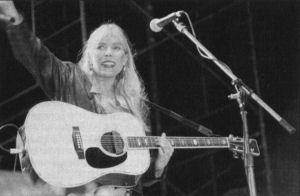
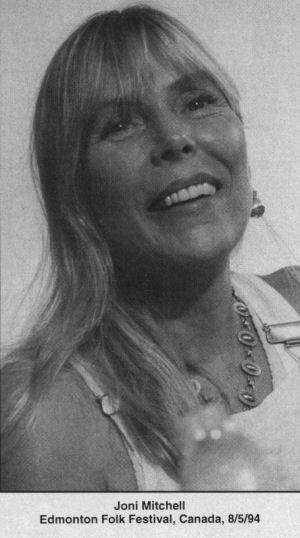
August 4, 1994: the opening night of the 15th annual Edmonton Folk Festival in Alberta, Canada, and the headliner is local legend Joni Mitchell. She looks resplendent as she strides out and throws on her guitar with a beaming smile, those golden prairie locks shining under the stage lights. The sky is a twilight blue and as the stars appear, so do hundreds of candles on the hillside where 7,000 people stand in mid-ovation. She checks the tuning and breaks the air of anticipation as she strums out the beginning to "Night Ride Home." Mitchell is back home, with her first performance here in about 20 years. In fact, this is one of only a handful of performances since her last tour 13 years ago.
Joni Mitchell was born Roberta Joan Anderson on November 7th, 51 years ago. "I was born in Fort MacLeod, Alberta in the foot hills of the Canadian Rockies - an area of extreme temperatures and mirages. When I was two feet off the ground, I collected glass and cats. When I was three feet off the ground, I made drawings of animals and forest fires. When I was four feet off the ground, I discovered boys and bicycles. When I was five feet, I began to dance to rock 'n' roll and sing the Top Ten and bawdy service songs around campfires, and someone turned me on to Lambert Hendrix and Ross and Miles Davis and later Bob Dylan. Through these vertical spurts there were briefly the church choir, grade one piano, bowling, art college, the twist, a marriage, runs in the nylons and always romance - extreme in temperature and mirages."
Most of her childhood was spent in Saskatoon in the neighboring province of Saskatchewan, the heart of the Canadian Prairies. "My childhood longing mostly was to be a painter, yet before I went to art college my mother said to me that my stick-to-itiveness in certain things was never that great, and she said you're going to get to art college and you're going to get distracted, you know." The art college Mitchell speaks of was in Calgary, Alberta, and the distraction was local coffee house folk scene. She tried learning folk guitar from a Pete Seeger instructional record, but decided she didn't want to copy any style and soon nurtured her own.
The love and success of performing led her east to the folk scene in Toronto to perform at the annual Mariposa Folk Festival. During the three-day train ride across the country she wrote her first song, a blues ditty titled "Day After Day." At the Yorktown in Toronto of 1964, Mitchell crossed paths with the other Canadian folkies like Neil Young, Gordon Lightfoot and Ian and Sylvia Tyson among others. There she also met and married singer Chuck Mitchell, and they relocated to Detroit where as a duo they were well received. Within a year they were separated, and the songstress headed for New York with little more than her guitar and new surname.
Elliot Roberts saw something special in Joni Mitchell when she opened for Richie Havens at the Cafe Au Go Go in Greenwich Village in '67. He quickly became her manager and secured her a record deal with Reprise, but before she began recording, others were snatching up her songs. Tom Rush recorded "Tin Angel," "Urge For Going" and "The Circle Game," which he used as his album title. Buffy Sainte-Marie also did "The Circle Game" and "Ode To A Seagull." Judy Collins sang "Michael From Mountains" on her
Wildflowers album and had a hit with "Both Sides Now." Soon Mitchell covers were recorded by Johnny Cash, Gordon Lightfoot and over in England where Fairport Convention covered "I Don't Know Where I Stand" along with "Chelsea Morning" on its first record. The topper of them all was Fairport's gorgeous version of "Eastern Rain." Of Mitchell, Judy Collins said, "When Joni writes, she finds the words that unthread the confusion and paints scenes as vivid as her watercolors. When she sings the circle is completed."
 |
| Photo by Ralph Hulett |
Mitchell spent part of '67 in London and Florida, where David Crosby was blown away by her performance in Coconut Grove. They started a romance and went to California where Crosby produced her first album. "When he said he would produce me, the record company was confident that he would produce a folk-rockish thing...but all along David was planning to perpetuate a hoax and preserve the beauty and intimacy he liked in my music." The album, simply titled
Joni Mitchell, is a warm one with only Mitchell on guitar and piano, plus a little bass by Stephen Stills. Mitchell establishes a few themes she would continue to explore, namely the adventure of romance - with the city, with traveling and with lovers. She even included a song about the couple's time spent on Crosby's boat, "The Dawntreader."
By the end of 1968, Mitchell hit the major scenes of the year. Forty weeks on the road kicked off with the Miami Pop Festival, followed by festivals in Atlanta, Newport, Big Sur, New York and Monterey. She opened for the new Crosby, Stills and Nash combo and met Bob Dylan while appearing on Johnny Cash's TV show. In February of '69, Mitchell made her debut at Carnegie Hall. By October, her second record,
Clouds, which included her own versions of "Both Sides Now" and "Chelsea Morning," was released. Featuring a self portrait on the cover, the album is also self-produced, a precedent that would continue throughout her career. It was recorded in much the same fashion as her debut, song structure, playing and singing. The instruments are all hers, and the layered harmonies approach pitch-sure perfect.
Two months after Mitchell won a Grammy for Best Folk Performance for
Clouds, she released her third record,
Ladies Of The Canyon. Around this time a romance was in bloom with Graham "Willy" Nash, and her song to him was on the new record. Her song of the Woodstock festival became the unofficial theme and was a hit for Crosby, Stills, Nash and Young. The four lads provided back-up vocals for her version of "The Circle Game" while "Big Yellow Taxi" provided her with her first hit. The song "For Free" about the incongruity of her status as a celebrity performer and the guy on the street who plays for free was later covered twice by David Crosby.
While she may have missed Woodstock, Mitchell did play at the Big Sur Folk Festival along with CSNY, John Sebastian, Joan Baez and Mimi Farina. The event was documented on film where she performs a jam on the mid '60s chestnut "Get Together." Another sequence is of her at the piano playing "Woodstock" that, and thanks to the filmmakers' insertion of images and color schemes, brings the song into the psychedelic realm, most likely the first time the word is used in conjunction with her music. Recently Mitchell stated that she was "glad there is a document of it, but it's also nice when the cameras aren't there and the music just goes up in the air."
Later in 1970, Mitchell performed at the Isle of Wight Festival in the U.K. where the band Matthews Southern Comfort's version of "Woodstock" hit number one. The following year found her touring the U.S. and Europe as she was set to record her next album. In August of '71, she recorded
Blue, an album that really laid out her feelings. At the time, she said of her candid songwriting, "I hang my laundry on the line when I write. People make judgments, and it's none of their business. It almost makes me decide not to write anything but fiction, but I have to do my thing."
Reviewer Robert Christgau said of
Blue, "...this battlefront report on the fitful joys of buy-now pay-later love offers an exciting, scary glimpse of a woman in a man's world." Even today the album stands out as a timeless testament to the female point of view in a tapestry of music that has aged beautifully. While
Blue may have unfortunately inspired a whole movement of lesser talented singer-songwriters to spill their guts over a piano ad nauseam, it did pave the way for today's outspoken female singers such as Sinead O'Connor, P.J. Harvey and Kim Gordon, and girl rockers like L7, 7 Year Bitch and Hole, who have taken Mitchell's pioneering efforts and matched them with a bit of primal scream in a new level of aggression for female rockers.
Joni Mitchell took a sabbatical from the music scene through most of 1972 when she bought land back in her native Canada, on the west coast in British Columbia, as a getaway. "I go there to write, as much time as I can take," Mitchell said recently. "I'm taking longer and longer every year. I unplug the phone, and you can't get a hold of me." Part of the reason for her prolonged absence could also be attributed to her treatment in the press.
Rolling Stone in particular drew her ire by publishing a diagram of her alleged love affairs, crowning her "Old Lady Of The Year." It would be eight years before she would grant them an interview.
In early '73 she came back with the album
For The Roses, which spawned her biggest hit to date "You Turn Me On, I'm A Radio." The album's added color through various instrumentation would continue through her work as she began to record largely with ensembles. "My music is becoming more rhythmic. It's because I'm in Los Angeles, and my friends are mostly rock 'n' roll people. I've always liked it. When I was in Saskatchewan, I loved to dance."
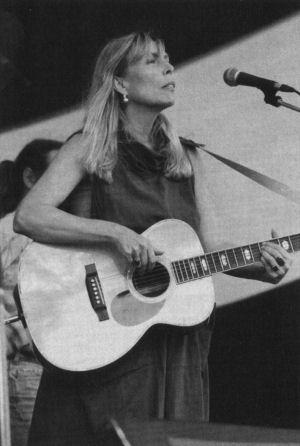
Court And Spark, released in the spring of '74, was Mitchell's first fully electric album and at the height of the singer-songwriter trend, put her at the top of the heap. Three singles from the album quickly became some of her most popular songs, "Help Me," "Raised On Robbery" and "Free Man In Paris." She also hit the concert trail with a vengeance: a 72-date tour with the L.A. Express, a jazzy sophisticated ensemble, took her new sound on the road. Mitchell's music was now more of a cultivated free-form pop sound, growing farther away from the genteel folk pop of her early records. Her old buddies CSNY were also back on tour, and Mitchell joined them and The Band at a packed Wembley Stadium in England.
 |
| Photo by Mike Jamont |
Her next release was the double live album,
Miles of Aisles, that captured her concert sound with her band. A live version of "Big Yellow Taxi" was an even bigger hit than the original. Her sound, now slicker with the proficient backing of the L.A. Express, found her moving more into the mellow laid back West Coast style. It seemed the wild soundtrack of the '60s generation was now evolving into adulthood as the baby boomers matured, settled down and stopped listening to revolution rock.
Mitchell's next record proved that she wasn't content to ride the middle of the road. From then on, her music took even more experimental moves. Released in '75,
The Hissing Of Summer Lawns really stepped out musically, daring her fans to join her. Those that did found the term "folk" scarcely applied. If anything, this was jazz-like. In any case,
Hissing was certainly not
Court And Spark Part Two. Synthesizers, saxes, flutes, brass and even the warrior drums of Burundi (long before Paul Simon incorporated world music) all played out in adventurous sonic endeavors. No longer singing about the ladies of the canyon, Mitchell now addressed ladies of suburbia (albeit in a cynical fashion) on "Harry's House-Centerpiece" and, while not dressing like an earth mother, she sill romanticized a part of her that would never go away in the lure of "The Boho Dance." The press for the most part was not favorable although the record sold well, and it was evident Mitchell was more interested in art over album sales. "Every career undulates," she said recently. "I did some of my best work at a time when I had fallen from grace, same with Bobby (Dylan)."
In fact, Bob Dylan, who had, at the time, undertaken his most ambitious tour yet with the Rolling Thunder Revue, where he was augmented by a top-notch band and loads of friends like Bob Neuwirth, Roger McGuinn, Joan Baez and Allen Ginsberg, eventually persuaded Mitchell to take part. She was also there the next year when The Band gave its farewell performance as The Last Waltz. Mitchell used both of these events to showcase new material and released her ninth album,
Hejira, in 1976. She again forged ahead stylistically, leaving confused fans and critics behind.
Hejira left most of the denseness of
Hissing behind in favor of a sparser sound, and the winter white cover established a contrast to the warm summer scene of her previous record. Inside were themes of travel and adventure, of a woman finding her place in the world of the mid-'70s. Songs such as the title track and "Coyote" were driven by her rhythmic electric guitar and the virtuosic bass playing of Jaco Pastorius. Predictably, the critics gave this one a hard time, and predictably Mitchell remained undaunted. She now says, "Some of my best records like
Hejira were slandered. So that stuff doesn't faze me. I know when it's good and when it isn't. You have to learn that stuff."
The following year was relatively quiet for Joni Mitchell, but she was obviously planning her next move, a record that would defy her critics and further alienate many fans. The album she released in early '78 was the ambitious two-record set,
Don Juan's Reckless Daughter. With symphonic dream tracks, full jazz undertones, abstract lyrics and side-long songs, Mitchell was really stretching the endearment of her listeners. But if they didn't know by now to expect such moves, then they weren't paying attention. This album was pivotal for a number of reasons. It was her last album to go gold, the beginning of a downward trend in sales, and it pretty much spelled the end of whatever interest radio may have had left. On the brighter side, she began a working relationship with jazz saxophonist, Wayne Shorter, which lasts to this day. Of this period, Mitchell said in 1991, "I started working in a genre that was neither this nor that. People didn't know where I fit in anymore."
The album attracted the attention of jazz legend Charles Mingus who was fighting Lou Gehrig's disease at the time. He liked what he heard and knew that a final collaboration with Mitchell might elevate his status with the younger generation who likely had never heard of him. He offered six melodies for her to write and sing lyrics to. On January 5th, 1979, Mingus died, and five months later her simply titled tribute,
Mingus, was released.
As was perhaps expected,
Mingus was panned critically and sales were less than spectacular. Jazz fans weren't too welcoming, and pop fans were perplexed. But who was surprised? Least of all Joni Mitchell. "I was considered an expatriate from pop music," she told
Rolling Stone. "Meanwhile the jazz folks thought, 'Who is this white chick?'" Mitchell summed it all up by saying, "You have two options. They're going to crucify you for staying the same. If you change, they're going to crucify you for changing. But staying the same is boring. So of the two options, I'd rather be crucified for changing."
In September of '79 Mitchell recorded a show for her forthcoming double live album and companion video,
Shadows And Light, featuring an ace band of jazz players including Pastorius and guitarist Pat Metheny with vocal back-ups by The Persuasions. Released in 1980, the selections were all post-'75, save for "Free Man In Paris" and "Woodstock." The sound was certainly more accessible than
Mingus. This was jazz-pop, and if anybody doubted the jazz aspect, there were solos listed for all band members.
In 1981, then Canadian prime Minister Pierre Trudeau inducted Joni Mitchell into the Juno Hall of Fame (Junos being the Canadian equivalent of Grammies). In 1982, Mitchell surprised many followers by making an about-turn musically with
Wild Things Run Fast, which included buzzing guitars, fast drums, pop choruses and even a cover of an old Elvis classic. This was early-'80s clean pop for the masses. Guest appearances by Lionel Ritchie and members of Toto may have been aimed at attracting a younger audience, but Mitchell primarily sang to her generation. That she had found and married a new love, bassist Larry Klein, was quite evident in the upbeat tone. Until recently, this was the last year that Mitchell toured. (Last summer Mitchell revealed that a bout with post-polio syndrome kept her from touring throughout the '80s although she concentrated on her first love of painting.) It would also be three years before her next record.
Dog Eat Dog, released in 1985, found Mitchell pursuing yet another new direction, this time using U.K. techno wiz Thomas Dolby as co-producer. The album is definitely of the mid-'80s with a cynical theme attacking the return of conservative leaders, selfish lifestyles and post-1984 where-are-we-heading dilemma.
Chalk Mark In A Rainstorm, released in 1988 was more contemporary without sounding forced. With help from Peter Gabriel, Tom Petty and Willie Nelson among the usual assortment of top studio players. Mitchell achieved a nice balance of modern sounds. It isn't folk and it isn't jazz, but has an accent on the beat with Mitchell credited for keyboards and drum programming.
 |
| Photo by Mike Jamont |
Joni Mitchell made a rare performance at Roger Water's massive Wall concert held in Berlin in 1990. The next year she released
Night Ride Home, which would be the last we'd hear for another three years. It received the least attention of all her work as Mitchell had now been out of the scene for so long. It's unfortunate because this release found a cozy medium between the technology Mitchell had experimented with throughout the '80s and some things that had all but been left behind - her acoustic guitar and her melodies. With no big-name guests and less synth, it was her most organic sounding record in years. The aural texture was sparser yet still brightly colored.
That direction continues on her latest release,
Turbulent Indigo, which Mitchell describes as having "...a minimal amount of layering. All the verses are just voice and guitar. It thicks and thins all the way along to give it more symphonic dynamics." Some of the songs were the highlight of her homecoming show in Edmonton. Before the show she had stated "I'm not a jukebox, I'll be playing later work for the most part, but that's the way it's always been. I like the idea that people would make new memories with the new material rather than just using me as a sentimental journey."
Her first solo concert in a long time was a tour de force. To finally hear the simple yet powerful dynamics of that jazzy Mitchell phrasing and unique guitar as it brushed up the hill was everything the crowd could have hoped for. Sparkling renditions of "Cherokee Louise," "Moon At The Window," "Hejira" and the new "Sex Kills" and "Yvette In English" (co-written with David Crosby) were indeed the soundtrack to which new memories were made. For the faithful, Joni relented and played "Big Yellow Taxi" and "Woodstock."
Does a new record and a solo appearance at a folk festival for the first time in eons mean that Joni Mitchell is back? "I'm testing it out again, I'm putting my toe in the water," she said following the concert. If so, it would be a welcome and long overdue return by one of music's most talented, daring and individual artists.
Printed from the official Joni Mitchell website. Permanent link: https://jonimitchell.com/library/view.cfm?id=2255
Copyright protected material on this website is used in accordance with 'Fair Use', for the purpose of study, review or critical analysis, and will be removed at the request of the copyright owner(s). Please read 'Notice and Procedure for Making Claims of Copyright Infringement' at JoniMitchell.com/legal.cfm